 Project Details
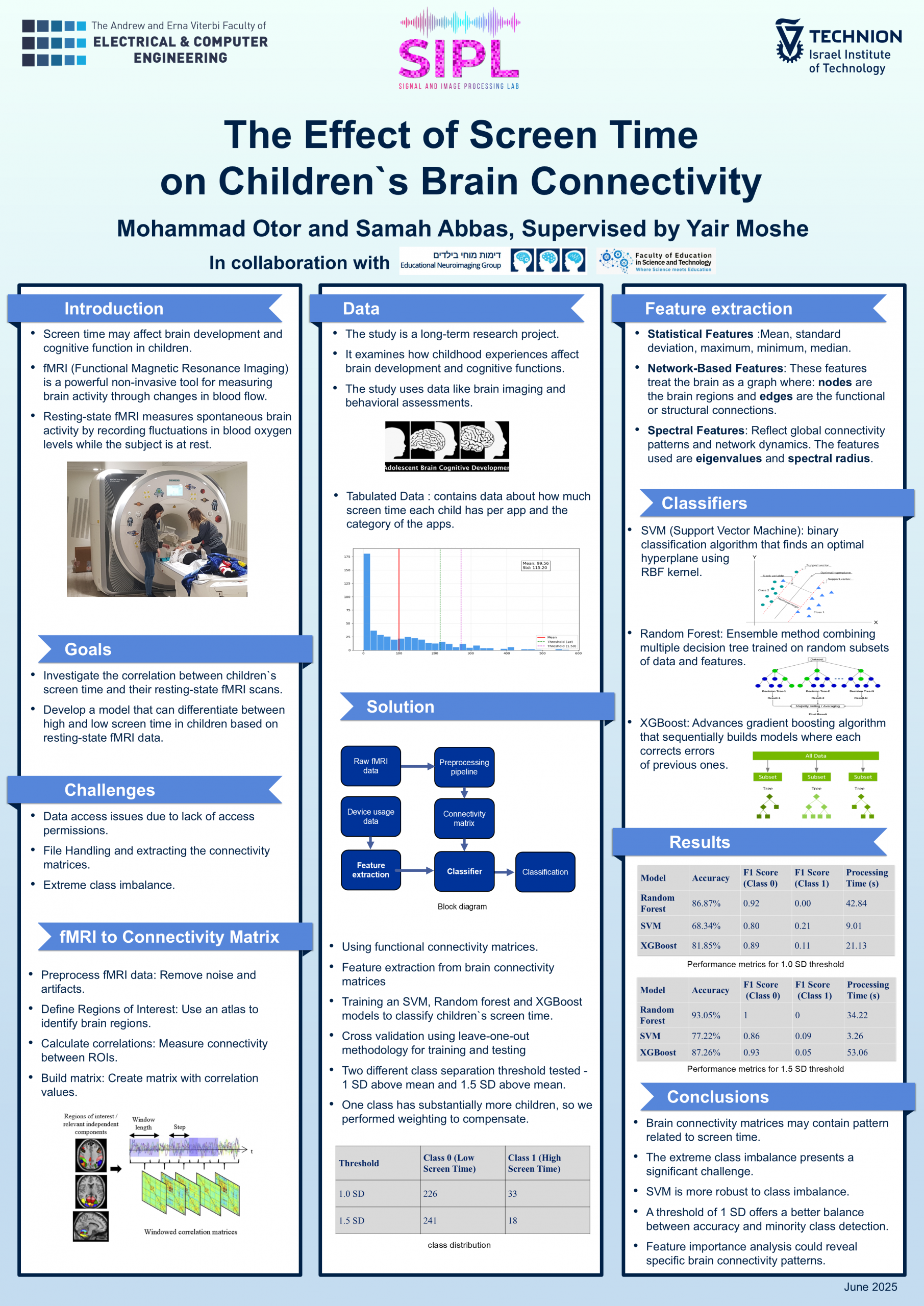
This project investigates the relationship between children's screen time and their brain connectivity patterns using resting-state fMRI data. We developed a classification model to differentiate between high and low screen time levels based on functional brain connectivity matrices. We employed three machine learning algorithms: SVM, Random Forest, and XGBoost, extracting 30 features from each connectivity matrix. Results show that while it is possible to classify children by screen time based on brain connectivity, the main challenge stems from significant class imbalance, which casts doubt on the generalizability of the methods we tested. Random Forest achieved 93.05% accuracy at 1.5 standard deviations threshold, while SVM showed the best ability to detect high screen time children.