 Project Details
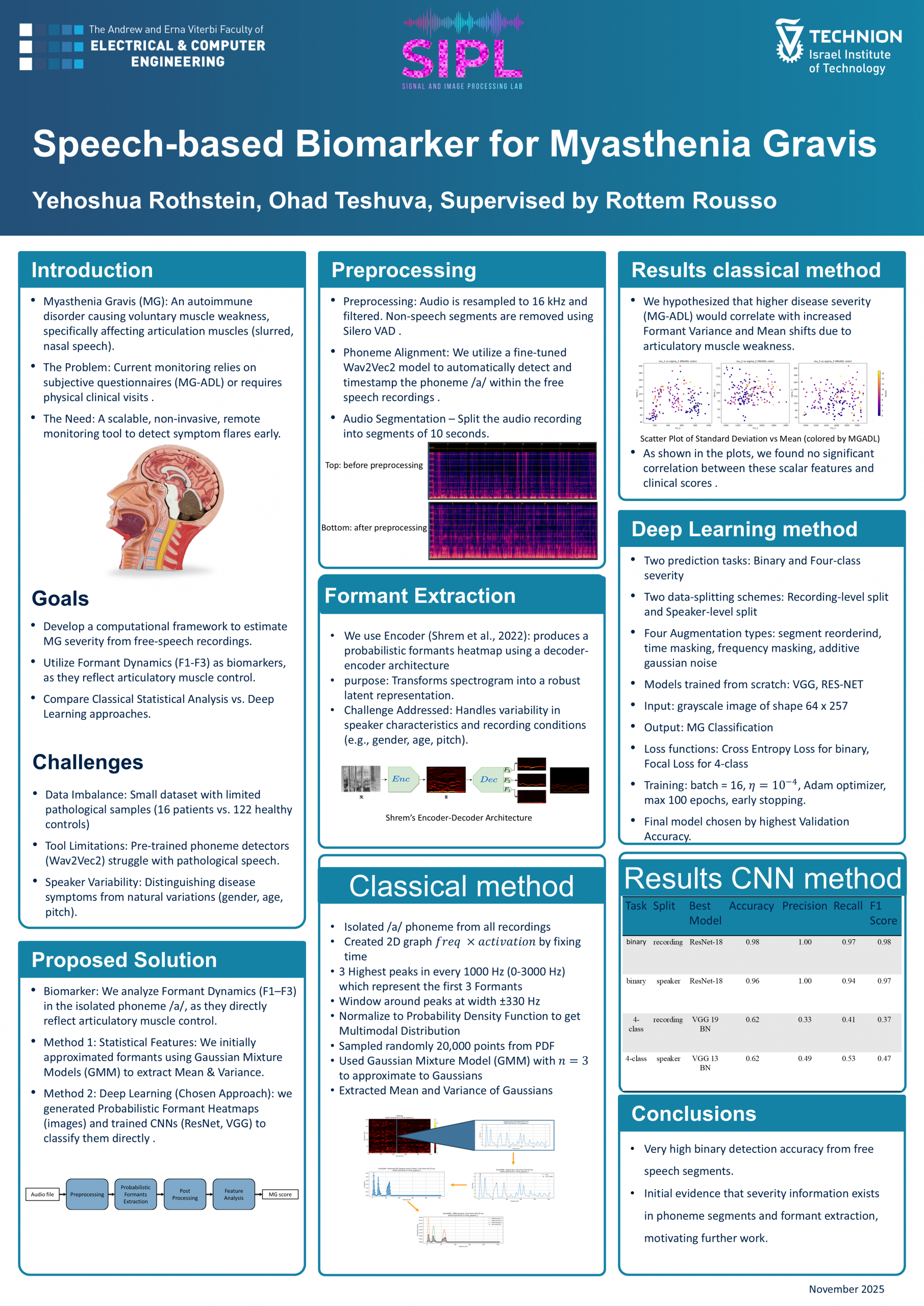
Myasthenia Gravis (MG) is a chronic autoimmune neuromuscular disease characterized by progressive muscle weakness, frequently affecting speech production. While current clinical evaluations rely on periodic in-person assessments, there is growing interest in speech-based biomarkers that can provide continuous, non-invasive monitoring of disease severity. In this project we propose a computational framework that derives disease severity from free-speech recordings by combining domain-invariant spectrogram encoding with phoneme-specific extraction and deep learning models. Our dataset contains 66 recordings from 16 MG patients and 122 recordings from 122 healthy controls. We evaluate two deep learning splits: by recording, to test whether severity can be predicted based on prior recordings of the same speaker, and by speaker, to assess prediction for unseen speakers without prior knowledge. We address two prediction tasks: binary (healthy vs. pathological) and four-class severity (healthy; mild, medium and severe). We trained and evaluated VGG and ResNet models. Results were: 0.98 for binary classification with the recording-level split; 0.96 for binary classification with the speaker-level split; 0.62 for four-class severity with the recording-level split; and 0.62 for four-class severity with the speaker-level split. Our findings suggest that segmenting a single phoneme from free speech is a viable path to extend prior binary MG detection toward multi-class severity estimation.