 Project Details
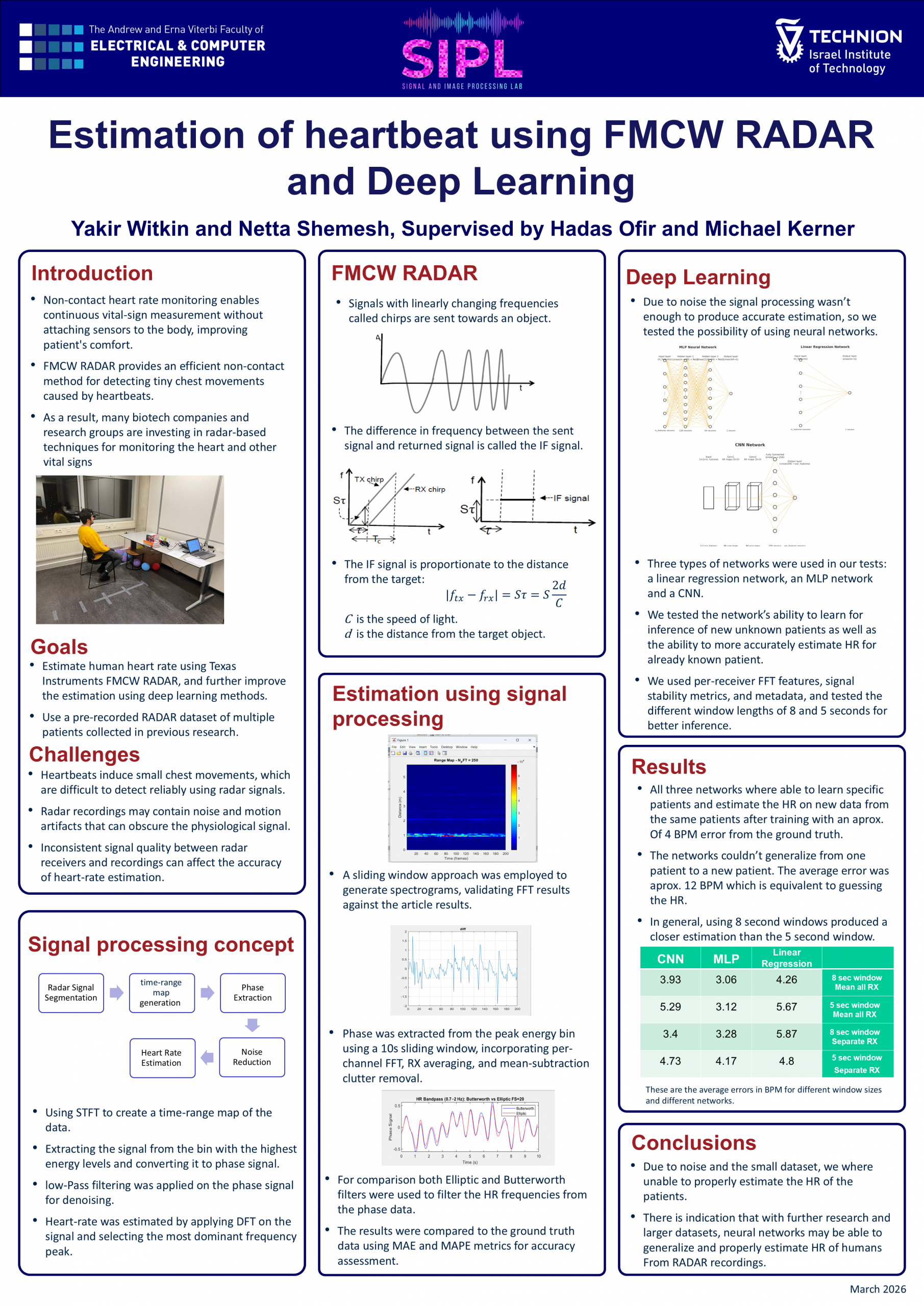
This study presents the development and comparison of algorithms for remote heart rate monitoring using FMCW radar, with the goal of enabling non-invasive vital sign measurement under noisy and distorted signal conditions. The research was based on radar recordings from ten participants collected at a hospital in the Netherlands. The methodology consisted of two stages. The first applied classical signal processing techniques, including phase extraction from the IF signal, noise filtering, and FFT over sliding time windows to produce a time-range map from which a continuous signal was extracted from which the heart rate could be estimated. In the second stage of the project three learning models were implemented - MLP, CNN, and linear regression - trained on spectral features and metadata extracted from the raw signal to predict heart rate as a scalar output. Results showed that the classical method achieved good accuracy for a single subject (MAE 5.25 BPM) but struggled to generalize across subjects due to signal incoherence and reception distortions. The MLP model outperformed the classical approach, achieving an MAE of 3.06 BPM. Performance further improved by processing receiver channels separately (“Separate RX”) and by extending the analysis window to 8 seconds, which stabilized periodic heart rate estimation. Overall, deep learning demonstrated improved robustness to physiological variability and noise, though broader and more diverse data are required to achieve strong generalization to unseen subjects.