 Project Details
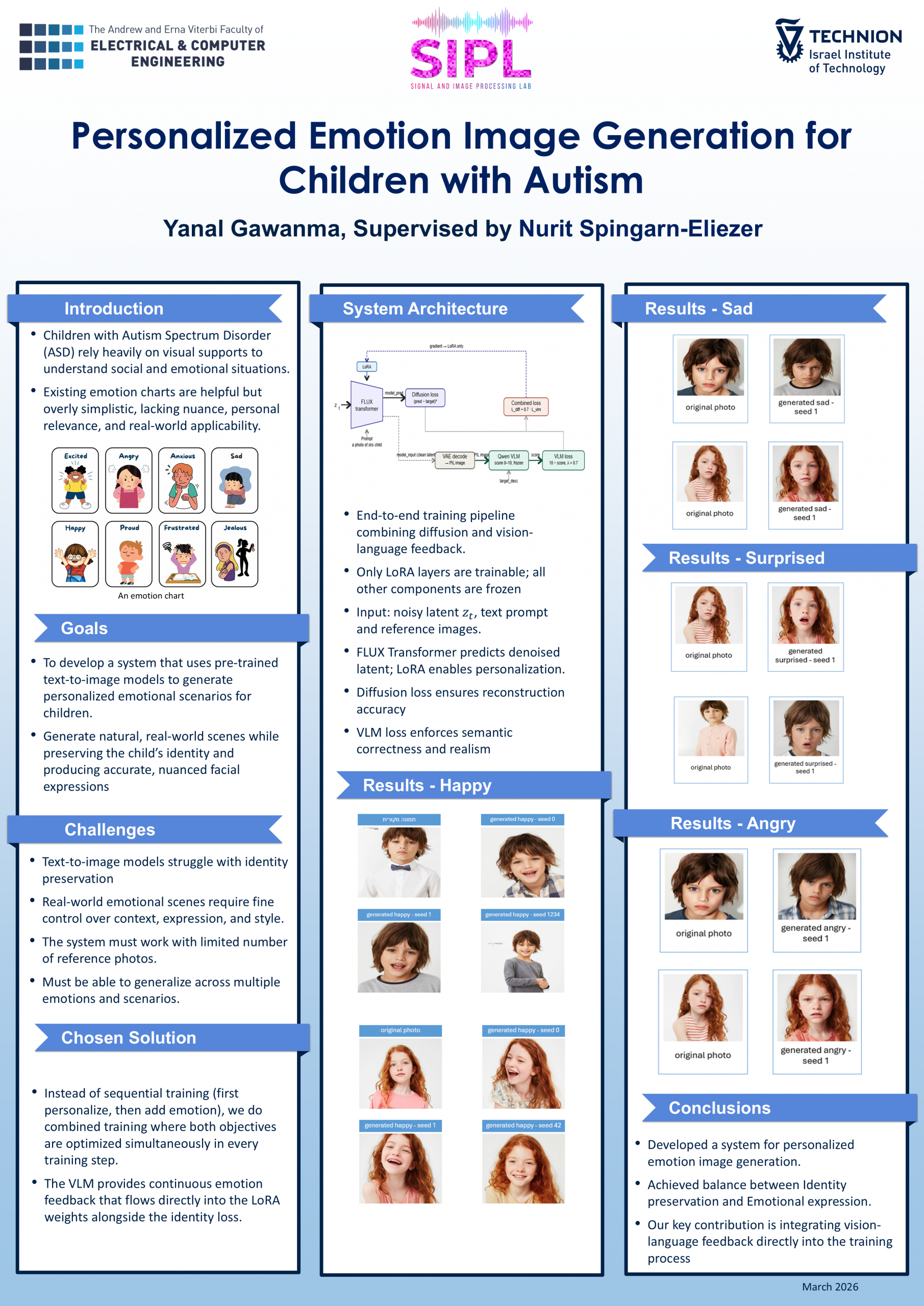
This project involves the development of a system for generating personalized emotional images for children on the autism spectrum, addressing the common challenges these children face in identifying, understanding, and expressing emotions. To provide a comfortable and safe environment for practice, the system moves beyond generic imagery of anonymous figures; instead, it utilizes generative models to create images of a specific child, preserving their unique identity while accurately modulating their emotional expressions (e.g., happy, sad, angry, surprised). On the technical side, the project integrates a diffusion-based text-to-image model, personalized via techniques such as DreamBooth and LoRA, with a Vision-Language Model (VLM). While the generative model focuses on recreating the child’s likeness, the VLM evaluates the alignment between the generated image and the target emotional description to provide a quantitative score. This score is incorporated as a component of the loss function, allowing the system to simultaneously maintain identity and optimize for the desired emotion during training. The results demonstrate that the model successfully preserves the child’s identity across most examples while producing distinct and recognizable expressions for various emotions.