 Project Details
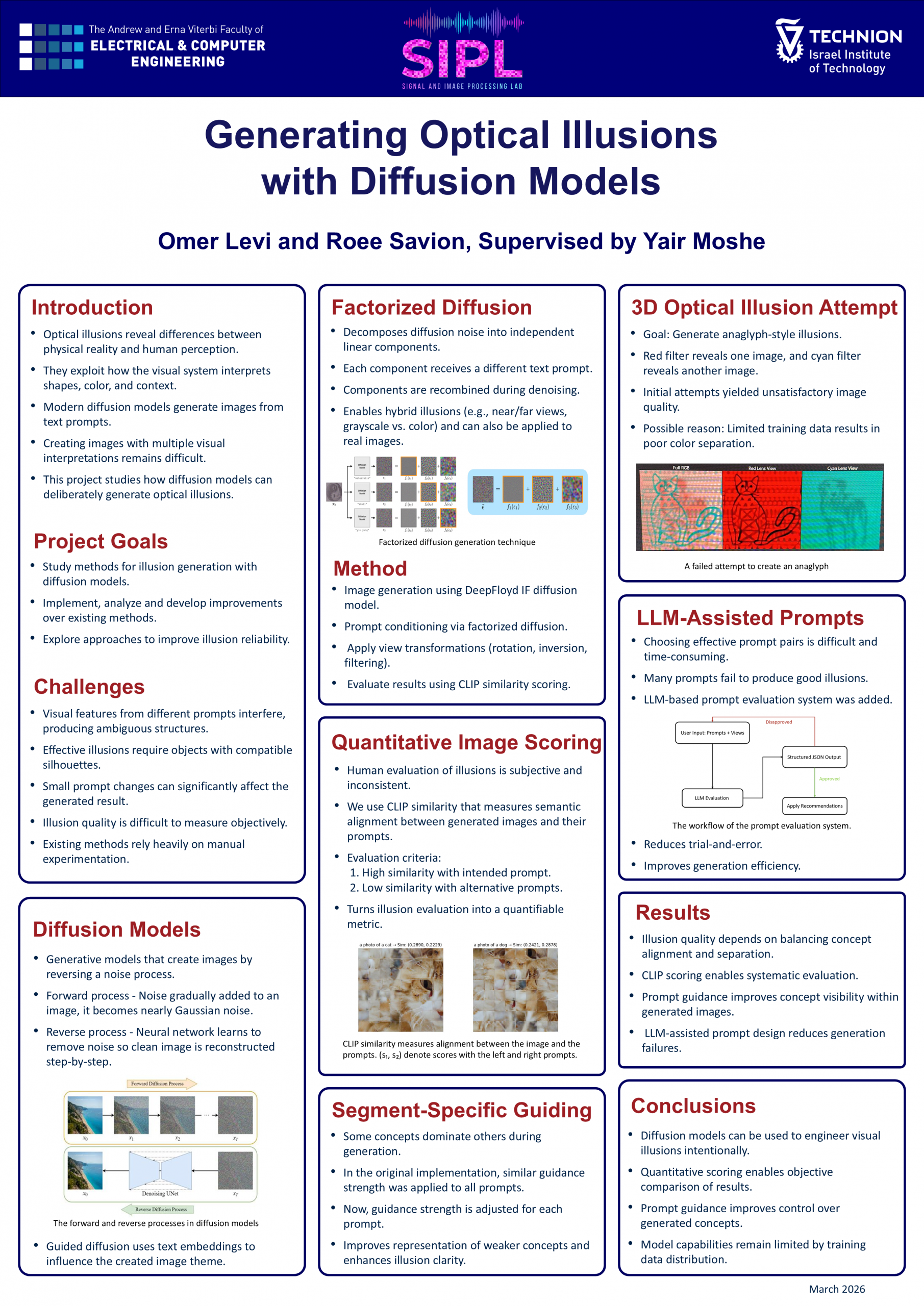
In this project, we explored how to create and improve optical illusions using generative diffusion models, with the goal of combining multiple meanings into a single image. Unlike the usual use of diffusion models, where an image is generated from a single text prompt, the aim was to create one image that can be interpreted differently depending on viewing conditions or processing. During the project, existing methods for generating optical illusions were analyzed and reproduced computationally. We also proposed an extension to the guidance mechanism (Guidance Scale), where each prompt has its own guidance weight instead of using one global value, allowing more precise control over how meanings are encoded. In addition, we used a language model (LLM) to improve prompt formulation, and CLIP to measure how well the generated image matches each prompt. The results show that weighted guidance improves the stability of the illusions and helps separate different meanings under various viewing conditions. In contrast, attempts based on color channel separation for 3D perception were not successful, suggesting limitations in how diffusion models represent such effects. Overall, this work shows that diffusion models can be guided to create more complex optical illusions through better control of guidance and prompt design, while highlighting the need for deeper understanding of their internal representations.