 Project Details
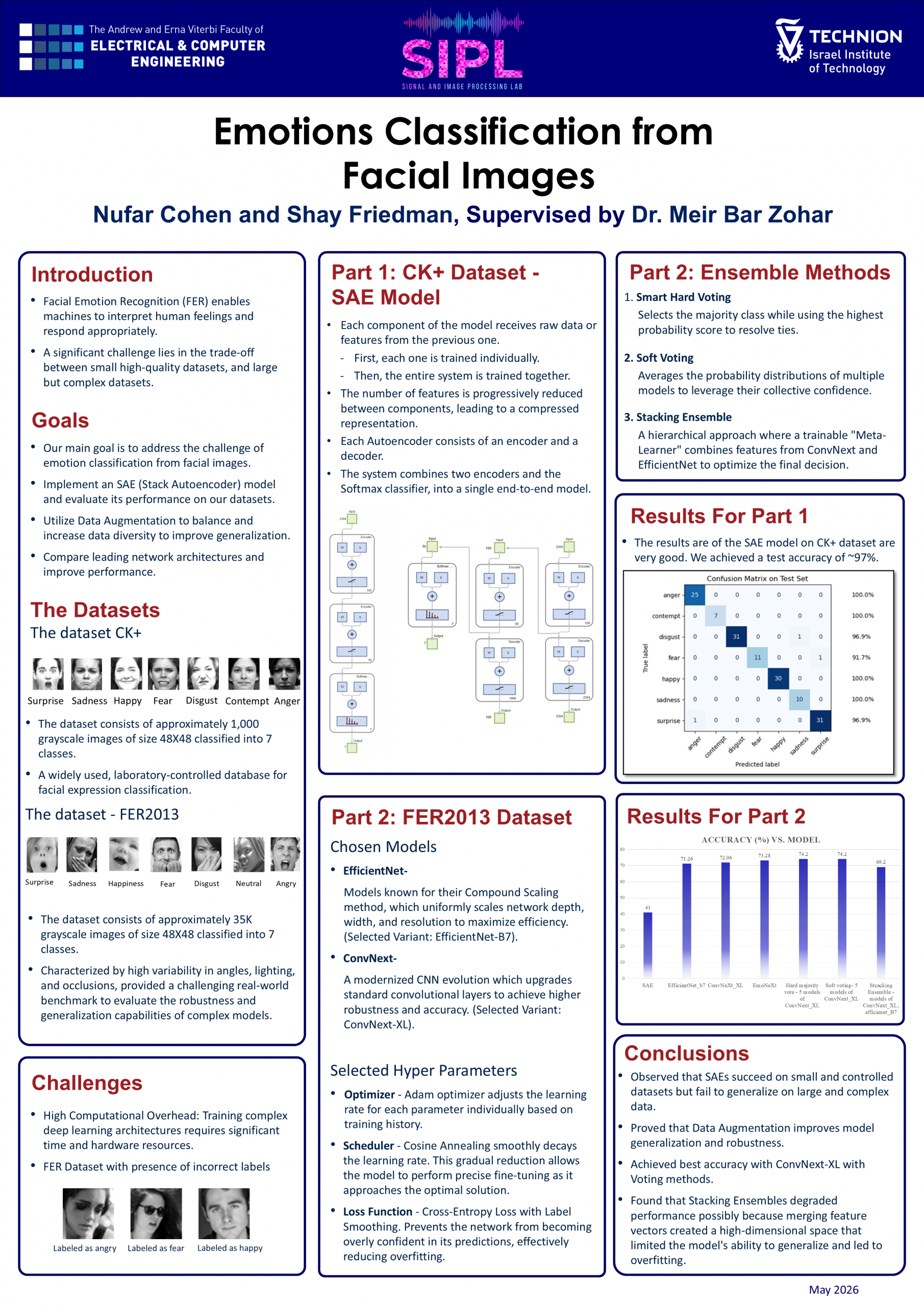
Facial expression recognition is a major challenge in image processing, heavily influenced by the quantity and quality of available data. This project focuses on developing and optimizing emotion classification models using two approaches tailored to the specific dataset's nature. In the first phase, for small and controlled datasets, a Stacked Autoencoder architecture was implemented. This approach utilized unsupervised learning for efficient feature extraction via MSE reconstruction, followed by supervised training of a Softmax layer for final classification as well as supervised fine-tuning for the entire stacked model. In the second phase, advanced deep learning architectures - primarily ConvNeXt and EfficientNet, were evaluated for larger, more complex datasets. The investigation focused on comparing performance under different optimization methods, including aggregating predictions from various model runs into a single output. Results demonstrate that the Stacked Autoencoder achieves high accuracy on small datasets despite limited data and a low parameter count. In contrast, performance on complex datasets remains lower even with deeper networks. Therefore, achieving optimal results requires combining predictions from multiple models using majority voting techniques.