 Project Details
Photoplethysmography (PPG) enables non-invasive heart rate monitoring in wearable devices, but motion artifacts during physical activity severely degrade estimation accuracy. Classical signal motion artifacts during physical activity severely degrade estimation accuracy. Classical signal processing methods, such as autocorrelation-based peak detection, perform well at rest but deteriorate significantly during walking, where motion-induced noise obscures the cardiac signal.
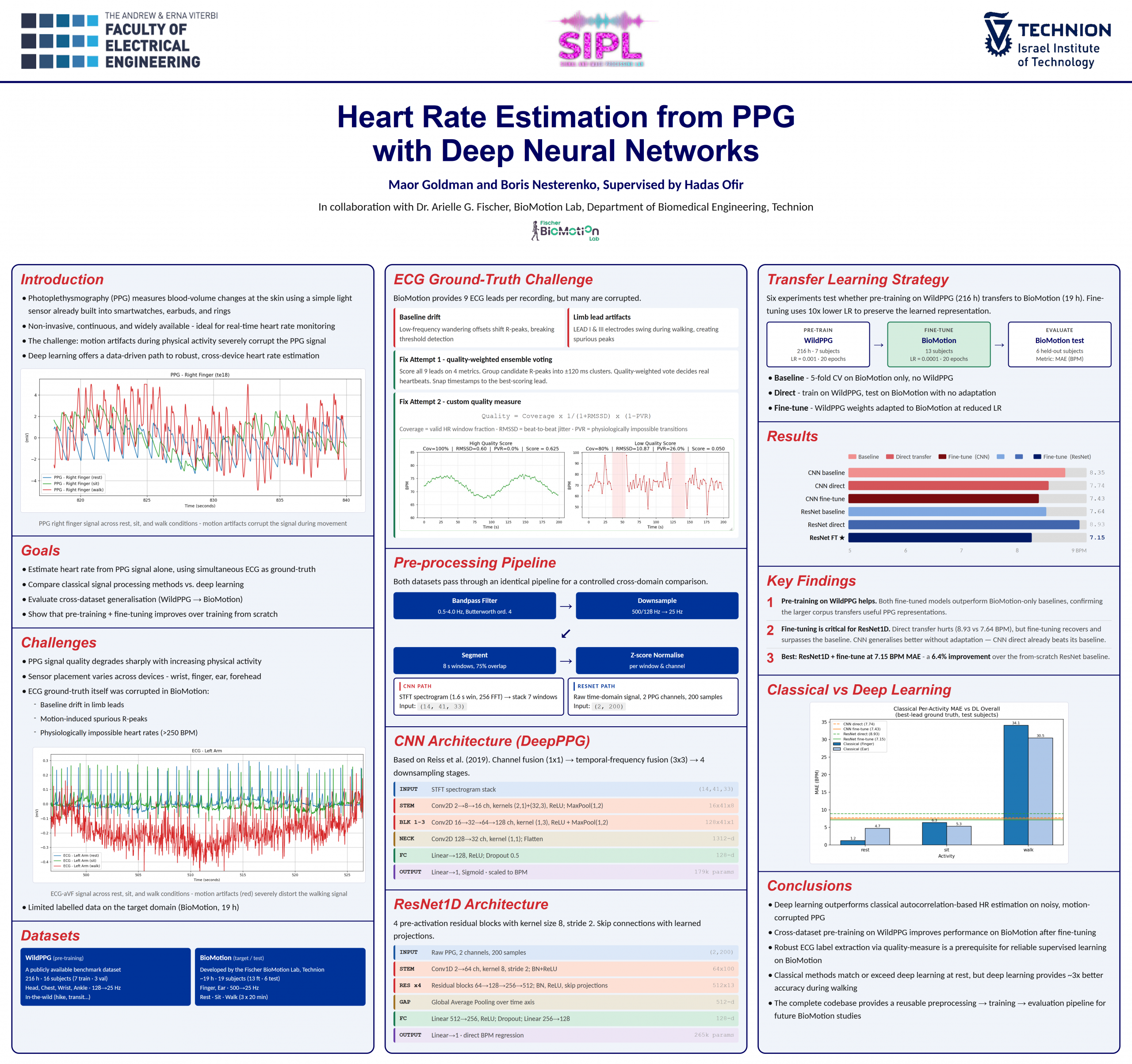
This project investigates whether deep learning models can overcome these limitations, and specifically whether cross-dataset pretraining improves generalization. We compare two architectures - a 2D CNN operating on STFT spectrograms (DeepPPG) and a 1D ResNet operating on raw time-domain signals - across two PPG datasets: WildPPG, a publicly available benchmark dataset (wrist and head sensors, ~170 hours from 10 subjects), and BioMotion, a dataset developed by the Fischer BioMotion Lab at the Technion (finger and ear sensors, ~19 hours from 19 subjects). Synchronized ECG recordings serve as ground truth, with R-peak detection via the XQRS algorithm providing per-window heart rate labels.
A significant portion of the project was dedicated to assessing and improving the quality of the BioMotion ECG ground truth. We developed a systematic quality scoring metric that identified corrupted recordings and selected the optimal ECG lead per subject and activity, enabling more reliable HR labels for model training and evaluation.
Our experiments show that models pretrained on WildPPG and fine-tuned on BioMotion outperform models trained on BioMotion alone. The best result, a ResNet1D with two-stage training, achieves 7.15 BPM MAE on the BioMotion test set - improving over the BioMotion-only baseline (7.64 BPM). During walking, where the classical autocorrelation method yields MAE above 20 BPM, the deep learning models maintain stable performance, demonstrating roughly above 20 BPM, the deep learning models maintain stable performance, demonstrating roughly threefold improvement in robustness to motion artifacts.