 Project Details
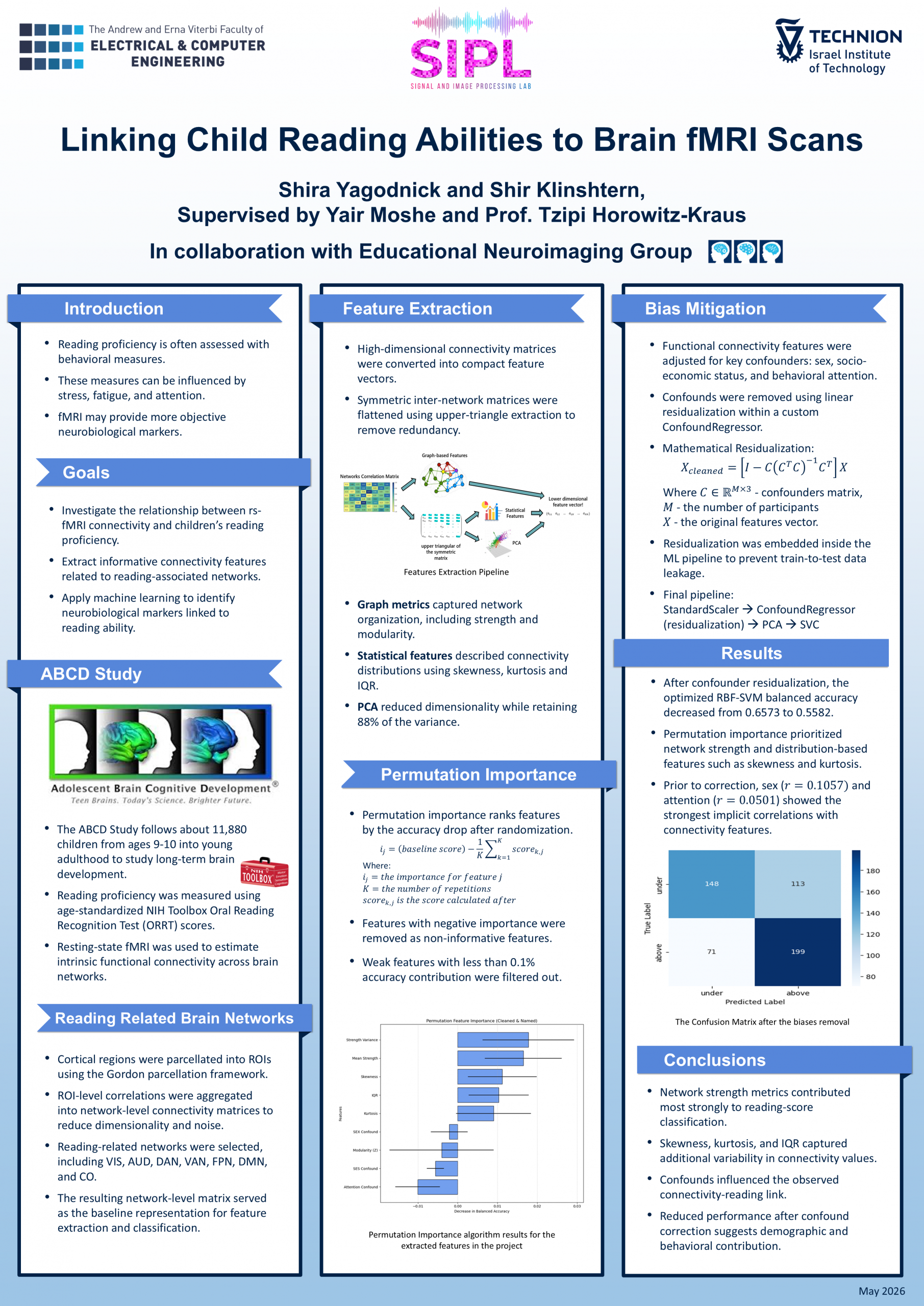
This project investigates the relationship between neural activity and reading abilities in children. Brain activity is measured using functional Magnetic Resonance Imaging (fMRI), a technology that maps active brain regions and their connectivity during cognitive tasks. Reading skills were assessed via the Oral Reading Recognition test. The project's goal is to analyze whether specific brain activity patterns are correlated with measured children's reading scores. Understanding these associations can contribute to identifying neural markers that provide objective data for evaluating reading abilities, as an alternative to existing behavioral metrics. To do so, we applied machine learning methods and feature extraction techniques. We implemented a binary classifier aimed at distinguishing between high and low reading scores based on brain scans. We filtered data belonging only to neural networks associated with reading. We extracted different features from the scans, and identified which features contributed most to classification performance. This process yielded a classification accuracy of 65%. Furthermore, we investigated the influence of demographic variables, such as gender and socio-economic status on the accuracy. The data used in this project was taken from the ABCD (Adolescent Brain Cognitive Development) study dataset, the largest long-term study of child health and brain development in the United States.