 Project Details
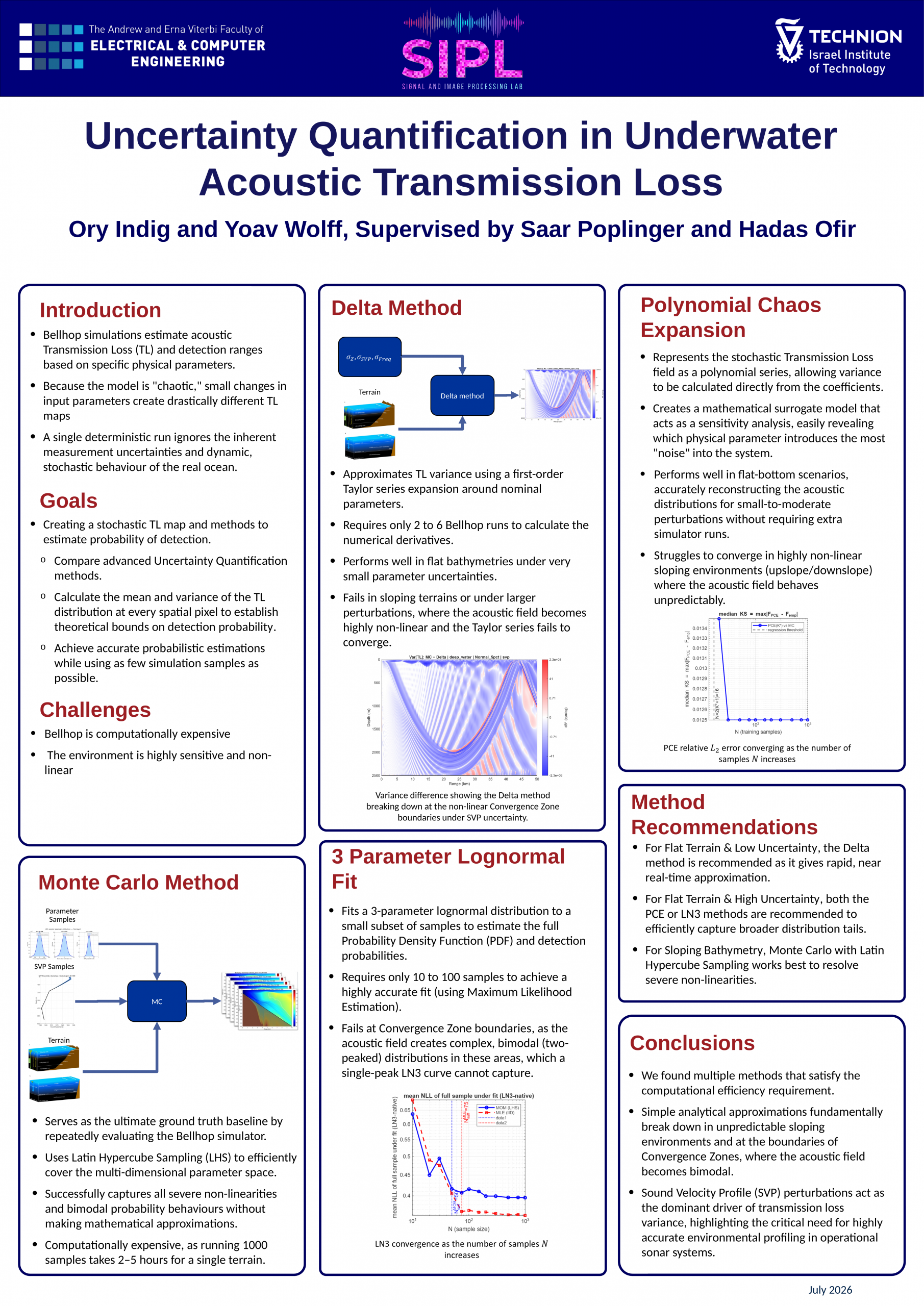
The primary role of sonar is detecting objects in the marine environment. However, estimating its detection range constitutes a complex challenge due to the dynamic and random nature of the marine environment, which produces unique wave propagation phenomena. This study examines how to estimate the probability of detection under environmental uncertainty using a stochastic approach, by evaluating the response of the deterministic acoustic propagation model ’Bellhop’ (used for predicting sonar ranges) to uncertainties in its input parameters: sonar frequency, source depth, and sound speed profile (SVP). The research compares four main methods for Uncertainty Quantification (UQ): Monte Carlo (MC) statistics, the first- and second-order Delta Method (FOSM), parametric modeling based on a three-parameter Log-Normal distribution (LN3), and Polynomial Chaos Expansion (PCE). Performance was analyzed across 72,000 simulations encompassing four bathymetric regimes (deep water, shallow water, upslope, and downslope). The results demonstrate that the sound speed profile is the most dominant parameter, accounting for approximately 65% of the acoustic transmission loss variance in certain cases. Furthermore, while the Delta method is restricted to flat bathymetries with low uncertainty and PCE requires large sample sizes for stable variance reconstruction, the LN3 model stood out for its impressive efficiency: it enabled an accurate reconstruction of the transmission loss distribution and detection probability estimation from merely a few dozen samples (excluding some pathological cases elaborated on in this work). The research conclusions provide an operational framework for selecting the optimal UQ method according to environmental complexity.