 Project Details
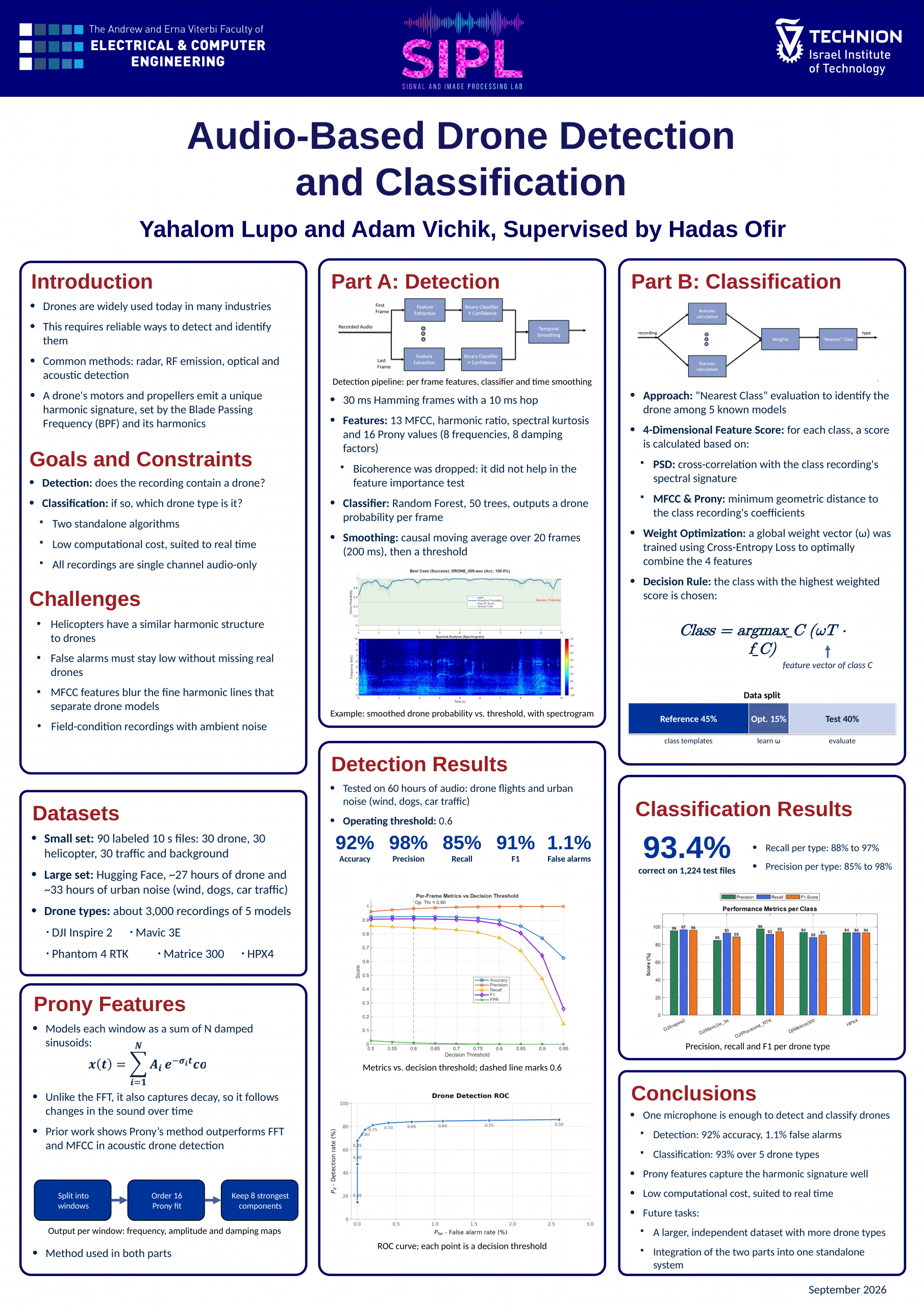
Drones currently serve as highly useful and prevalent tools across a wide variety of fields. There are numerous methods for monitoring and detecting drones, including radar, radio frequency (RF) emission detection, optical detection, and acoustic detection. This project focuses on acoustic detection by identifying the unique harmonic signature generated by a drone's motors and propellers, captured as an audio signal from a single audio channel.
Within the framework of this project, we addressed two primary questions: Does the audio file contain the sound of a drone, and if so, what type of drone is it?
For each of these engineering questions, we developed a distinct algorithm. Each algorithm is standalone and does not rely on the other. The first part was implemented as a machine-learning system using physical features selected for their ability to characterize the physical properties of the sound waves generated by a drone. The second part was implemented as a classical classification algorithm for several predefined drone classes. This algorithm determines the most probable class to which the drone belongs by comparing various physical features between the tested drone and the drones associated with each class.
In both parts, we demonstrated the feasibility of the algorithms in solving the problem, achieving highly successful results. For the first part, a detection accuracy of 92% and a false alarm rate of 1.1% were obtained. For the second part, we achieved a successful classification rate of approximately 93% utilizing a given dataset.