 Project Details
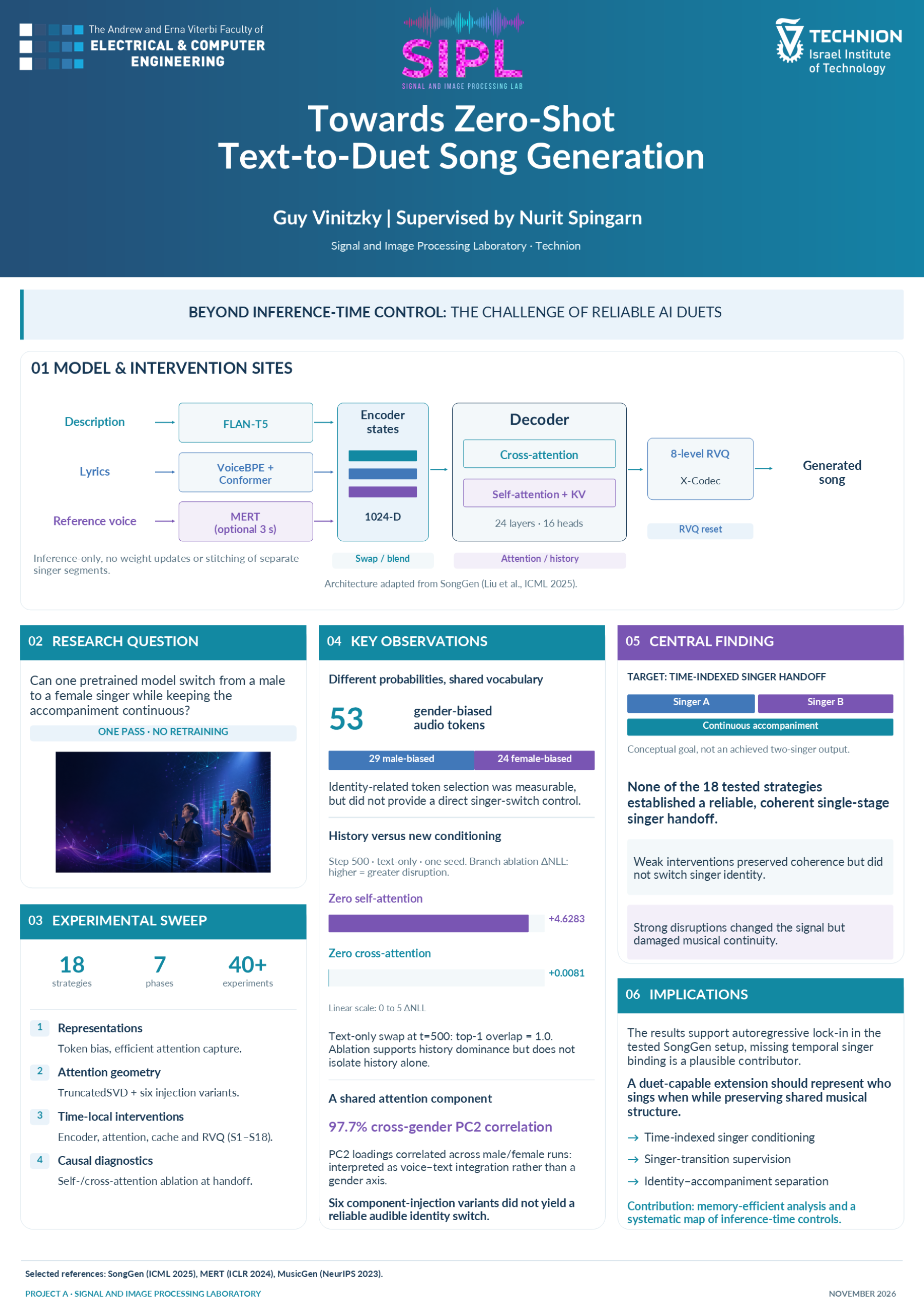
This report presents a systematic investigation into the feasibility of generating a coherent male-female vocal duet within a single autoregressive generation run using SongGen [7], without relying on audio concatenation during post-processing. To this end, various intervention strategies were evaluated across the generation pipeline - encompassing inputs, text embeddings, Attention mechanisms, Cache, and Residual Vector Quantization (RVQ) - all of which failed to produce a proper vocal transition. Nevertheless, the findings highlight three possible explanations: autoregressive lock-in, the lack of an explicit linkage between conditioning signals and the timeline, and hierarchical dependency within the RVQ. Additionally, aggressive cache interventions revealed a trade-off between musical stability and transition intensity, though this does not constitute the primary cause of the transition failure. Despite the negative outcome regarding single-stage duet generation, this work yields several contributions: the historical identification of 53 gender-biased tokens (29 male-biased, 24 female-biased), and a second SVD component (PC2) accounting for 30.76%–32.56% of Attention variance (exhibiting a 97.7% cross-gender correlation). These findings concern the tested SongGen configuration and interventions; they neither exclude all implementation errors nor prove that autoregressive models cannot generate duets.