 Project Details
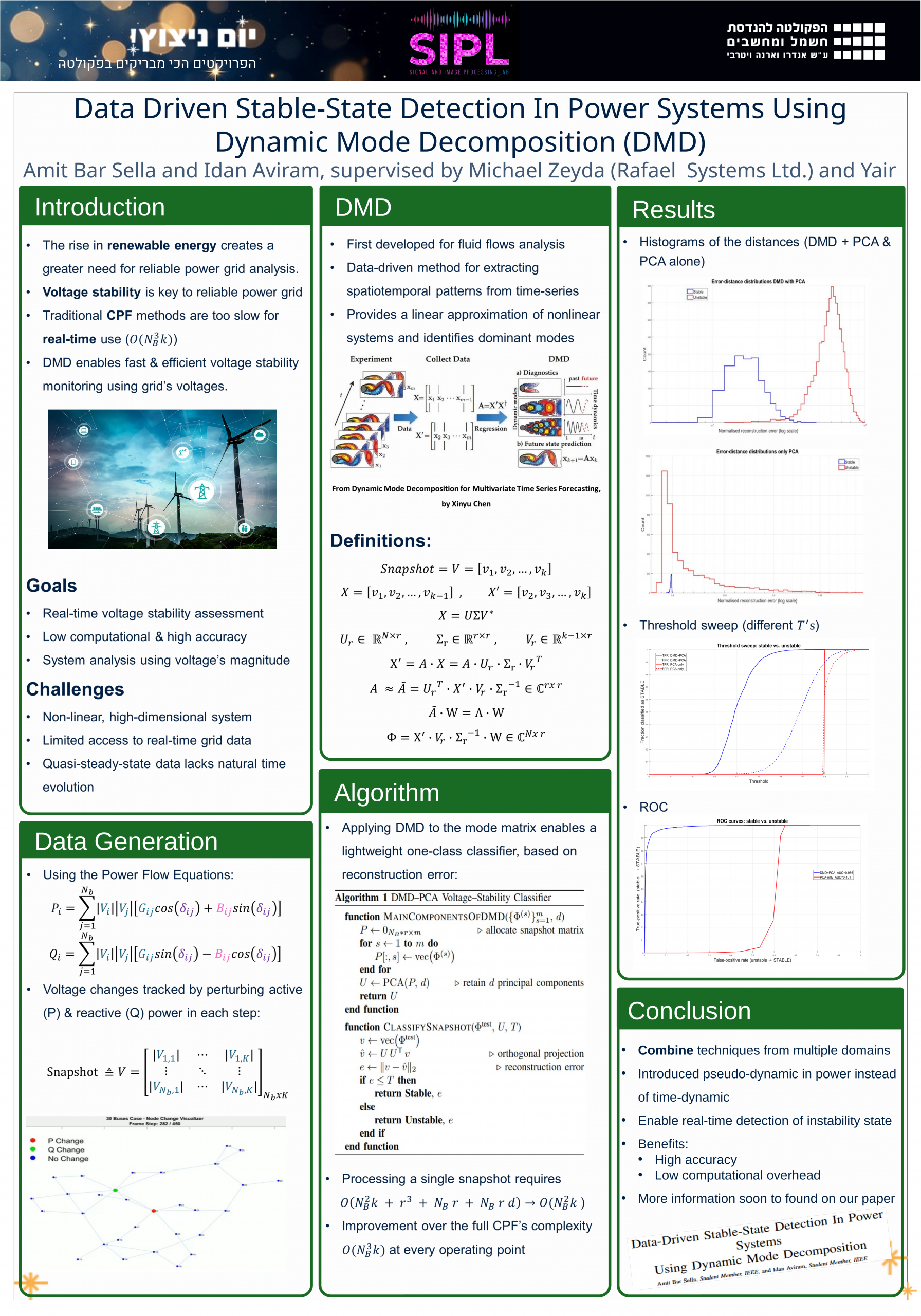
Voltage stability has emerged as a critical aspect of modern power-system operation and planning. Increasing penetration of renewable energy sources, highly variable load patterns, and evolving grid topologies demand analytical methods that are both accurate and capable of real-time insight. Conventional iterative power-flow simulations impose significant computational latency, rendering them impractical for rapid decision-making in complex grids. This paper proposes a data-driven framework for efficient voltage-stability assessment of small- to medium-scale networks. We employ Dynamic Mode Decomposition (DMD) to build a one-class classifier that separates stable from unstable operating points. Although the simulations are quasi-steady-state, pseudodynamics are introduced by sequentially perturbing bus loads, yielding snapshots that reflect spatially propagating demand variations. Compared with classical model-based techniques, the DMD pipeline dramatically reduces computational overhead while enabling near-real-time inference, demonstrating the effectiveness of coupling classical machine-learning techniques with model-reduction approaches in power-system analytics.